
Chapter1
Causality Shapes Markets and Marketing
How a slightly better understanding of causality can change how we perceive markets and marketing for the better

Section I
Causation is at the heart of marketing. But it goes without saying, right? It is at the heart of everything; however, not all jobs are equally affected by causation. If you are a programmer, for example, you are the main cause. You create the program. The moment you are done and your hands are off the keyboard, the effect of your efforts, the program, is there glaring at us. Causality here is all about, literally, pushing buttons until you get the desired effect.
The same does not apply to marketing, no matter how we would like it to. On the rarest of occasions, when the relationship between what we do and what we get is clear, we feel like something is off. And even if we do not, people question our work habitually. Was it the creative? The change in spend did make a difference, did it not? It is the new features the product team added that really moved the needle. Many marketers shy away from claiming effects as the result of their work because they are afraid of not being able to establish a clear causal link between what we do and what we get. So we find ourselves in a Catch-22 situation. We are held accountable for causing and maintaining results. But when we do get results, we cannot really claim them.
This is why marketers need to lend their attention to understanding the dynamics of cause and effect, to a degree where we find ourselves comfortable explaining our work, doing the best we can and getting recognized for the results.
Reaching a clear understanding of causation is a difficult endeavor. There is no consensus. Things become philosophical pretty quickly. Aristotle, Wittgenstein and Newton share a table with you. And boy does your head spin in such company. It does feel familiar, though. The way there are many schools of thought constantly debating without reaching a conclusion should feel very familiar to any marketing practitioner.
One way to approach such a challenge is to establish an initial understanding based on the available information and keep updating it whenever something comes up and challenges it. This is one of the ways we make sense11Gary Klein and his co-authors describe sensemaking as “a process of framing and reframing, of fitting data into a frame that helps us filter and interpret the data while testing and improving the frame and cyclically moving forward to further adapt the frame.” (Klein et al., 2007, p. 119) of things that are ill-defined.
Almost a year ago, in a random web search for something to make me a little bit smarter, I found Dave Snowden referencing research by professors Rani Lill Anjum and Stephen Mumford titled Dispositional Modality. This took me down the rabbit hole of reading their books Causation: A Very Short Introduction and What Tends to Be. The books were informative beyond measure and I really enjoyed being educated on such an essential topic at such depth of treatment. The books actually triggered my curiosity more than they satisfied it. Since then I have read a book by philosopher Alicia Juarrero titled Dynamics in Action, on the topics of causality, intentionality and action, and am currently reading her second, more recent book, titled Context Changes Everything. I fathom that Juarrero’s work is going to be a cornerstone in this inquiry. We are just kicking things off, so let us wait and see.
This chapter is about constructing an initial frame on causality for marketing-specific use cases, using the lens professors Rani Lill Anjum and Stephen Mumford provided us with. It is not a book summary, though. We will be jumping from philosophical abstractions to marketing specifics and vice versa.
Section II
In What Tends to Be, the authors argue that up until recently causation was seen as one of two modalities: necessity (A should lead to B) or possibility (A, B and C are possible); however, these two modalities, they argue, do not help us explain what happens in reality. We, as marketers, struggle with this first-hand. A lot of times we are expected to answer questions about the future state of companies as if it were something as simple and as necessitating as A should lead to B. Other times, we are challenged by the possible. We feel it in our bones that something is not the best thing to do, but we are countered with: “It is possible, right? Let us experiment and see.” You find yourself frustrated by the idea that every possible thing should be tried. Not all possible things are equally probable or equally beneficial, right?
This is true insofar as the outcome of both situations is almost always regret and blame. The marketer then realizes the need to avoid claiming that we know what will happen, or that anything goes as a worthy experiment. At this point, marketers tend to avoid argumentation of any kind and make glamorous noise, just enough to keep the job.
The authors introduce a third modality that can change a marketer’s perspective for the better. Behold: the dispositional modality. Simply put, things (people, systems, companies, objects, etc.) have causal powers. These powers are disposed towards particular effects. Sometimes these effects are successfully manifested. The keyword here is sometimes. Obviously, we need to understand why.
If we observe reality, we notice that even the simplest of things, the things that are so disposed towards their effects that they merit being renowned as necessary, sometimes fail to be so. Given that you have a word processor program active on your computer, pressing the letter k on the keyboard tends to render it on the screen. But sometimes things interfere with this simple process and prevent its effect. Maybe the command button is pressed, so it activates a shortcut instead of writing k. Maybe the keyboard battery has died.22You can argue that my example is not an accurate account of necessity. I agree with you, but it is a good example of what we take for granted; call them mundane or pseudo necessities if you will. But this is the kind of necessity marketers deal with, so this will do.
My point is that even in the simplest of situations, causal powers do not have to manifest through their effects. In marketing, we deal with much more complex environments. Imagine invisible causal powers, interferences and effects racing around the default marketing context like a big pinball game where there are hundreds of levers, tens of balls and an ever-changing orientation that messes with how the entire game reacts, including you. From this we can infer that a causal power is not fully responsible for causing an effect. A bearer of a causal power is always part of a bigger system that bounds what is possible. That is to say that even if we recognize something that bears a causal power in our marketing environment (not a simple task by any means), it is not going to be as simple as triggering it to manifest its effect.
Section III
Perceiving causality through the lens of dispositions and tendencies is valuable for marketers on two fronts. The second one is the subject of the next section. The first one is how we perceive marketing and how we present it to others. When the illusion of simple, direct causality fades away, we are left with something more holistic and useful to the entire organization: coherence. Instead of being responsible for things to happen, you become responsible for understanding how things are and figuring out how to act accordingly.
Instead of being responsible for results, you become the owner of context, understanding it, shaping it and reacting to it coherently. You are not trapped inside comms anymore. Once again, you enjoy a healthy relationship with product and price. Everything stems from knowing more about the context than anybody else. People can mistakenly attribute some effect to a cause they favor. But you do not. You know how complex things are, how there is always more to it than the mere connection people like to establish.
I have always found it absurd to make the marketer accountable for the end result of a process controlled by so many people. It is equally absurd to think that making the marketer solely accountable for comms metrics will bring out the best of them. We have tried and seen that it makes us more isolated and lessens our degree of involvement in core marketing responsibilities like product and price. But why are these core marketing tasks, and why do we care to affect them?
Going back to the originator of the 4Ps, E. Jerome McCarthy emphasized the idea of customer centricity and shaped the marketer’s core activities around it. In the actual diagram from the book, it was illustrated like this:
The marketing mix. E. Jerome McCarthy, Basic Marketing: A Managerial Approach (1960).
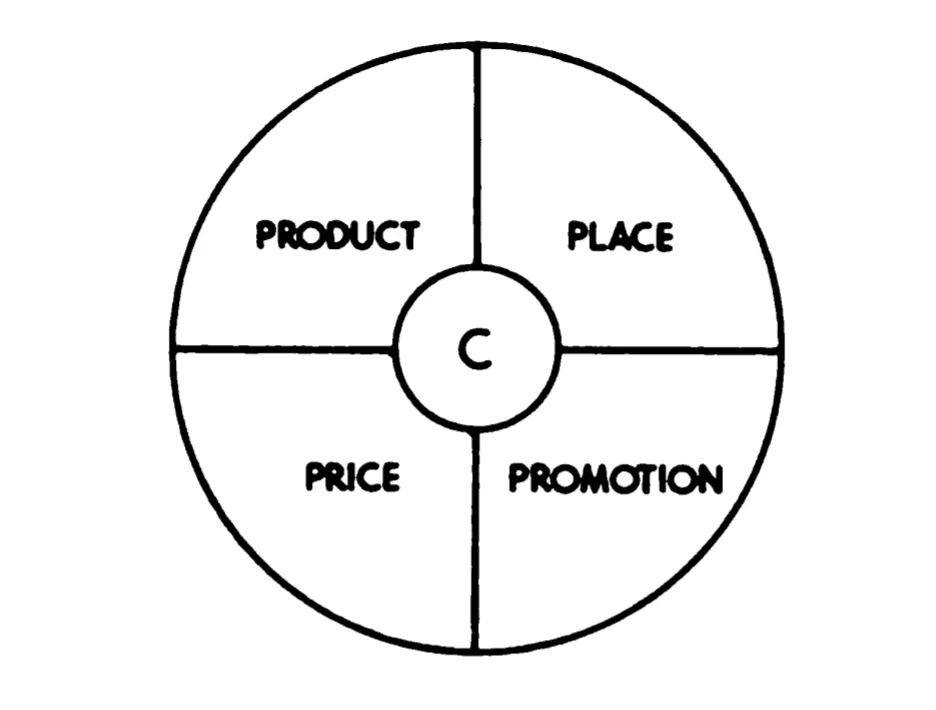
McCarthy argued that the 4Ps are controllable variables that the marketer can directly manage and affect. These were distinguished from uncontrollable variables that the marketer has no control over. The accumulation of controllable and uncontrollable variables amounts to the overall context in which a marketer operates.
The marketing manager’s variables. E. Jerome McCarthy, Basic Marketing: A Managerial Approach (1960).
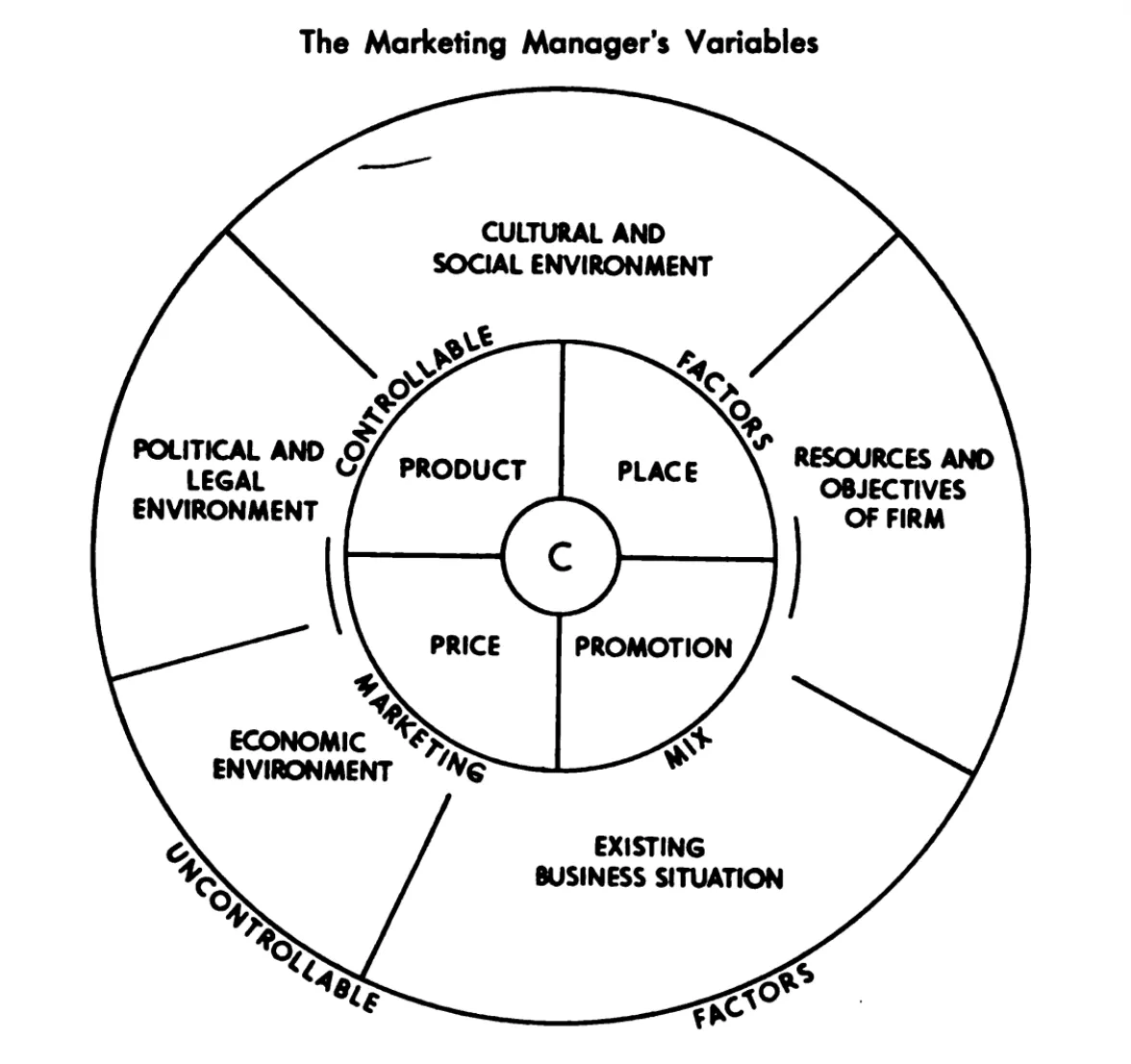
Now, I want to pause for a second and ponder something: who else inside a company deals with so many variables, many of which are outside their control? Perhaps CEOs? I cannot ignore the fact that marketing operates at such a level of variability and complexity because it is where we get lost in the trenches of this messy territory, but it is also where we can become better marketers.
In light of being owners of the context, I see the marketer’s job as going through a loop of three sequential phases:
- Understanding context
- Taking coherent actions
- Augmenting positive effects
The beauty of such an understanding is that it leaves a longed-for space for the particulars of every company. It is not always a growth-at-all-costs game. Patagonia played its own game and won according to its own terms. The same goes for hundreds of companies that did not take the clear path of “It is about more on every front: do more, hire more and sell more for more.” I am not bashing premium pricing or the effects of brand building. But this should be a deliberate choice out of many available ones, instead of being the only path forward.
So how should we perceive and present marketing? Maybe as the art of making coherent commercial decisions in a complex commercial context, for the sake of augmenting the most fitting outcomes. Instead of being known as craft-less people and imposters, our craft becomes context and coherence. This gives us a basis for evaluation, a direction for what we should be learning and a place at the table when important decisions are being made.
Section IV
How can we define a market in light of what we have learned about causality and the dispositional modality? In a sense, a market is an amalgamation of manifestations: it is the result of many complex systems interacting together, leading to people demanding something enough to form a market to satisfy it. This has two implications.
The first implication is that markets are a snapshot of what already happened, not what is going to happen. Sometimes the underlying demand that holds a market together just ceases to exist. For example, in the early decades of the twentieth century, hats were a big thing. It was rare to leave your house without wearing one. It was a social norm that signaled status and identity. And then it ceased to do these things, and its market fell apart. Other times, demand switches to a superior technological solution. We all know how Kodak reigned over the film camera industry for a long time, and then demand shifted gradually to digital. They did not manage to adapt to this change, even though Kodak was its originator.
Now, if you were responsible for marketing at Kodak in its golden days, or at a hat company in the early twentieth century, your market studies would always be about what has happened, not what is going to happen. The main issue is that we treat the former as if it were the latter. In the language of dispositions and manifestations, we can say that previous manifestations of dispositions do not guarantee or even represent future ones. A descriptive market study is a useful tool. But without context it can be detrimental.
The second implication is how we segment a market. The predominant way of segmenting a market is to try to draw lines between different clusters of people based on demographics, psychographics, behaviors and so on. The problem is that customers are not solely responsible for how a market takes shape. Manifestations are contextual. We have bearers of causal powers, the strength of the disposition itself, interferers and other causal powers at play. People do make their decisions. But, again, it is one thing to count how many people made a particular decision or picked a specific product; it is a completely different thing to describe what led to such a decision. This means that situation-based segmentation may help us preserve as much context as possible. It can give us everything we like about traditional segmentation and then some. We still can forecast the size of each segment, sort segments in a meaningful, actionable grid and even calculate our market share for each one. But we do all of this in light of how people act in actual situations, not in a context-less way that undermines how effects are caused. We will talk more about situations and their context when we discuss the works of Alicia Juarrero.
In the next chapter, we will look at a demand theory introduced in the book The Heart of Innovation by Matt Chanoff, Merrick Furst, Daniel Sabbah and Mark Wegman, and how it relates to the idea of dispositional modality. Both of these books have transformed how I understand demand, and I have high hopes for the result of putting them together for inquiry.