
Chapter2
How Demand Happens
Demand is contextual and only proven through people's actions

What is demand? From a causal perspective, we can think of it as a particular reaction to context that entails exerting resources for the sake of attaining something from reality. This definition has two pillars: 1) demand is contextual; 2) if there is no action, there is no demand. Let us discuss each.
Section IDemand Is Contextual
The journey towards a marketing plan entails a lot of reductionistic behavior. This is apparent in full glamour when creating customer profiles and segmenting a market. The epitome of segmentation is behavioral. You make distinct customer profiles based on how people behave in the wild. You cluster these profiles into distinct segments. You give each segment a dollar value. Then you pick. At this point you have made many gigantic assumptions, the biggest of which is that past behavior bears the causal powers responsible for the realization of future actions. This is simply not true.
This builds on top of another faulty assumption that the context in which people shop for whatever you provide is stable and passive. It also builds on top of a third erroneous assumption that people have static identities and that behaving in some fashion prevents behaving any other way. Assuming causality of behavior, passive stability of context and identity stasis leads to believing that you only have one variable to figure out; that is, behavior. Letting demand revolve around past behavior makes our job easier. It also makes it absolutely useless.
Elsewhere I argued that marketers are owners of context. If we agree on that, it is apparent here that such reductionistic behavior is self-destructive for marketers. If we undermine the one thing we own, we can expect to be undermined by others.
Now you might be thinking that what I am saying negates the second pillar of the definition, that if there is no action, there is no demand. Quite the contrary.
Section IINo Action, No Demand
Action is the proof of demand, not its cause, at least not solely. The act of buying something is the last step in a long or not-so-long process of interactions in a given context. It is the highest proof that there is demand for whatever is bought. It is not a guarantee that the same people are going to do the same thing again and again, though. Being concerned with the context in which this action takes place is beneficial to understanding demand much more than trying to describe how people behave in general terms.
To put it differently, to understand what leads a person to demand something in a specific context, it is not enough to know more about that person (especially when you cannot establish a relation between the details you are gathering and how demand has happened). On the other hand, you would be right on target if you concern yourself with the context in which demand has happened, its unique components and their interactions that ultimately have led to an action being taken.
Now if we agree that demand is contextual, it makes sense that different kinds of demand have different contexts. To deal with each properly, we need to know how it is different, understand the implications of this difference and choose the right tool for the job. In the next section we will have a brief look at two different kinds of demand.
Section IIITwo Different Kinds of Demand
You can distinguish between different kinds of demand based on how exactly you look at it: timing, size, competition, profitability, etc. Things like size, competition and profitability are self-explanatory. But what do we mean by timing?
Cedric Chin distinguishes between two kinds of demand based on when exactly you deal with it. The first is ex-ante demand. Ex-ante demand is the demand you have not found yet. Options are equally probable and demand for whatever you have in mind has not taken shape yet. It is more a mystery really. Your job with this kind of demand is to verify or falsify its existence.
The other kind of demand he introduces is post-facto demand. It is when you know, for a fact, that demand exists. It has shape. There is competition. Previous offerings have come and gone. Post-facto demand has history and its context is glaring at you, waiting for you to understand it.
The goal of ex-ante demand is verifiability, the goal of post-facto demand is scalability. Different orientations demand different tools and mindsets. The rest of this chapter will be concerned with a useful tool for exploring and verifying ex-ante demand and how we can explain it in light of causality and the dispositional modality.
Section IVThe Worldview of Deliberate Innovation
Deliberate innovation is the overarching philosophy of The Heart of Innovation. In contrast with accidental innovation, deliberate innovation is intentional. It is about not being stuck in a maze of assumptions and prejudices. Instead, you seek insights that help you limit your biases and either validate or invalidate your idea in the shortest cycle possible.
This section is not intended to be a summary of The Heart of Innovation. For that you can read Cedric Chin’s summary.
Innovators Tend to Be Delusional
It is human nature. We really are delusional. We select information that supports our prejudices and disregard anything else. We keep going when it is obvious it is not worth it because of sunk cost. And we rapidly jump to conclusions. It is not all bad, though. Sometimes it helps to be delusional. I remember reading about the idea of a reality distortion field in Steve Jobs’s biography. He used to distort reality in a way that helped his team get incredible things done within timeframes that were basically impossible from a realistic view.
When dealing with demand, though, it is actually bad. As we said, demand is about actions. No actions, no demand. Tricking ourselves into believing that there is action while there is not is a long and painful path towards failure. This is why deliberate innovation is designed around these biases and aims to get us over them successfully.
Complete vs. Incomplete Innovation
The authors of The Heart of Innovation distinguish between complete and incomplete innovation. Here is their take on complete innovation:
An innovator’s goal is a complete innovation. Innovations aren’t complete until they become embedded in the world outside the innovator’s head. So, unlike a complete song, a complete innovation depends on other people adopting it and bringing it into their lives in some way — being involved with it, whether involved means joining the team or investing or partnering or (most important) buying and using the products.
(Chanoff et al., 2024, p. 12)
This means that complete innovation is reciprocal while incomplete innovation lives exclusively (and maybe shortly) in the innovator’s own mind. This also pinpoints the role of action in completing the innovation cycle.
The Centrality of Non-indifference
Taking an action to obtain something is the opposite of indifference towards said thing; therefore, non-indifference is the heart of innovation. It is what gives weight to their definition of authentic demand:
Authentic demand arises when would-be customers experience not buying as a problem, as something they can’t be indifferent to, almost as a violation of something important.
(Chanoff et al., 2024, p. 14)
The idea of non-indifference is not common amongst marketing conversations. Pain points, needs and desires are much more prevalent. But which is a superior proxy for demand? To answer, we need to think in light of what brings people to take an action more than the others do. In this sense, pains, needs and desires have less power compared to non-indifference. People can and do live with pain, we almost always have unmet needs and we do not manage to satisfy every desire we have. It is only when we are not okay with something or the lack of it that we start taking action. “Not okay” here does not mean not being comfortable with something. Discomfort is synonymous with pain. What I mean by non-indifference is that we actually cannot settle down. Something has to be done. Something has to change. This is the state of non-indifference I am communicating. It is as if they cannot not act.
Not Nots as an Anti-delusion Mechanism
Now we know that:
- Innovators are delusional.
- Complete innovation is reciprocal. Innovator creates; people act on the innovation.
- For people to act on an innovation, they have to be non-indifferent to it.
Based on this, the authors of The Heart of Innovation gave us the idea of not nots. A not not is a state that represents non-indifference. When you meet a person who cannot not act on something, you are in the presence of a not not.
We have all been in situations where non-action was not an option. It almost feels necessary. This is not just about a desire or a need. It is an integrated configuration that entails you, but also many other things.
The job of the deliberate innovator is to hunt for not nots that are relevant to whatever they are building. The authors explain why it is difficult to look for not nots and what to do about it:
If you’re an innovator bent on building something that will matter to people and that they will accept into their lives, there’s nothing worse than indifference. What could be worse than pitching your pet idea and then watching your audience wander away, not even disliking your idea, but just not caring about it and letting it drift out of their minds? That makes indifference hard to see, in two different ways. It’s difficult emotionally when you see it. And it easily avoids notice, because we’re strongly motivated to confirm our positive preconceptions. But when you pay enough attention, you’ll see indifference everywhere, and especially with respect to your innovative ideas. Always remember, the things that people are nonindifferent to are things they cope with, that they get a grip on. Whenever there’s a not not, there’s probably a situation that people have built so that the not not will not be violated. Unmet authentic demand crops up when situations change that they’re not equipped to cope with.
(Chanoff et al., 2024, p. 113)
Now, non-indifference is all about action. What about the other pillar of demand, context?
Situation Diagrams
To incorporate context in deliberate innovation, the authors introduced a useful tool called situation diagrams. Basically, they see that every situation consists of actions, relationships, equipment/resources and channels. Each has a box in the situation diagram.
The situation diagram. Matt Chanoff, Merrick Furst, Daniel Sabbah and Mark Wegman, The Heart of Innovation (2024).
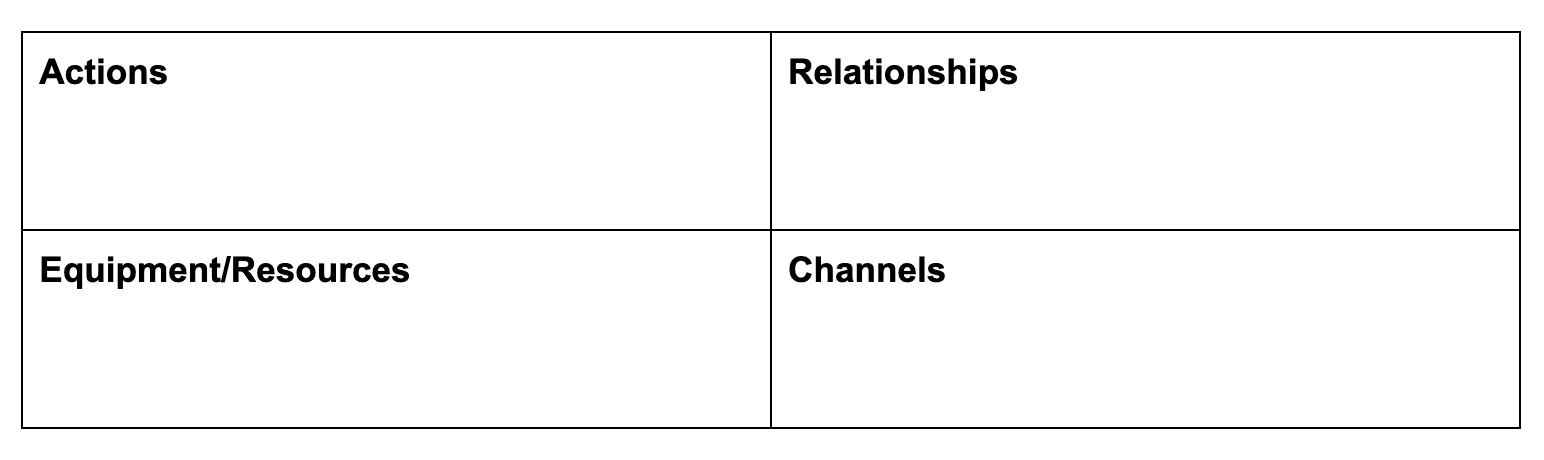
The four boxes are for the four parts of a situation that an observer can see and test: 1. Actions: people doing things 2. Equipment/Resources: products and services used in the performance of actions 3. Relationships: activities by people other than the person whose actions we’re looking at, serving as a resource for those actions 4. Channels: pathways by which equipment or other people’s actions reach and impact the situation.
(Chanoff et al., 2024, p. 126)
By mapping a situation into these four boxes, an innovator is more likely to uncover authentic demand by noticing not nots that can be the center of their innovation. The way to do this is through an interview technique they discuss in the book called Documented Primary Interactions (DPIs). Explaining it is beyond this walkthrough. You can reference the book or the writings of Cedric Chin too. Both are excellent and have helped me really internalize the ideas of deliberate innovation.
One last thing that needs to be explained is whether not nots are actually necessary or not. This is the sole subject of the last section of this chapter.
Section VCausal Powers, Tendencies and Not Nots
Let us lead with a quote from the book explaining the point of view of the authors:
Not nots are not musts. Sometimes they fail; sometimes people forget or circumstances intervene or more compelling not nots take precedence. But in any case, they matter. Also, not nots don’t only show up in desperate situations. You can’t place them somewhere on an intensity spectrum between whims and necessities. Also, they can’t be categorized as conscious or unconscious. People don’t walk around with a strong desire to avoid getting their fingers pinched in a door.
(Chanoff et al., 2024, p. 126)
While the idea of a not not signals necessity of occurrence, it is obvious from this quote that the authors know that it is not necessary. What is not obvious is why. Thankfully there is an explanation to be found in the work of professors Rani Lill Anjum and Stephen Mumford.
In the previous chapter we have seen that a causal power tends toward its effect. Tendencies have internal and external principles to which they adhere.
The internal principle of tendencies states that even with nothing interfering with a tendency, its effect may not take place. Sometimes a tendency succeeds in producing its effect, sometimes not.
The external principle of tendencies states that any cause can be interfered with. This interference can be subtractive (by removing something from the context that the realization of an effect depends on) or additive (by introducing something to the context that prevents the realization of an effect).
This explains a lot. A not not, no matter how non-indifferent people might be to it, is still just a causal power that tends towards its effect. Sometimes it realizes this effect, sometimes it does not. And it is not just because something may interfere (external principle), but also because it is inherently tendential.
Understanding not nots in light of the principles of tendencies helps us make sense of how they do not necessitate the realization of non-indifference, yet still carry the causal power that sometimes manages to make people non-indifferent.